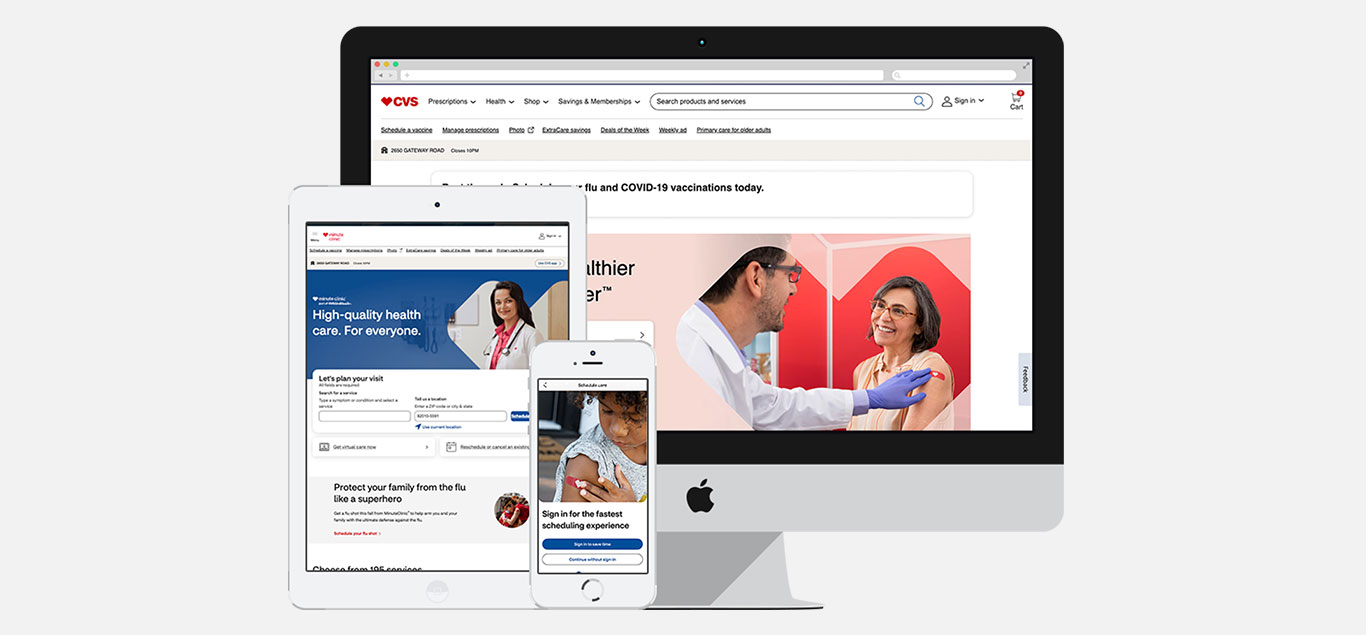
A platform built for 2020
I joined CVS's digital team, formed under the Operation Warp Speed (OWS) initiative, as the first doses of the COVID-19 vaccine became available to the public. CVS's role during the pandemic was to work closely with government agencies, health officials, manufacturers, and distributors to expedite COVID-19 testing and vaccines. We were tasked with maintaining trust and delivering critical healthcare services in the face of ongoing, post-2020 disruptions and shifting public needs.
Navigating complexity without a map.
Each year introduced new complexity, we adapted the experience to match.
Building trust in uncertain times
Combating misinformation with credible, clear health guidance. Making COVID-19 testing accessible when people needed answers fast. Streamlining vaccine appointment scheduling during the chaotic early rollout.
Reducing cognitive load
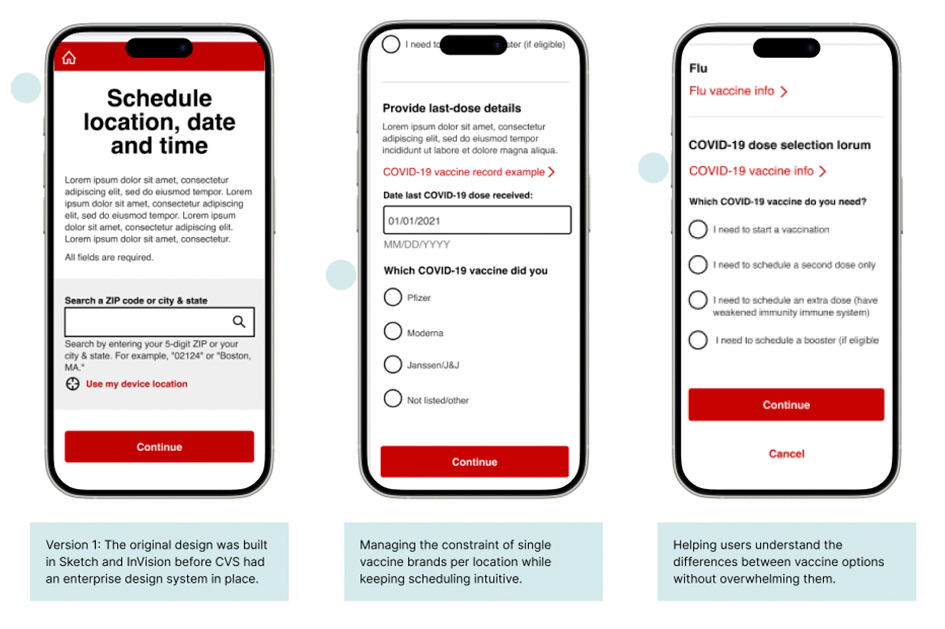
Helping users understand the differences between vaccine options without overwhelming them. Meeting the highest accessibility standards following DOJ settlement requirements.
The original system was built using Sketch and InVision but lacked a cohesive design system library, resulting in inconsistencies across the enterprise. Additionally, it had to navigate complex constraints tied to manufacturer-specific COVID-19 vaccine requirements, along with strict safety protocols governing the timing between doses.
Simplifying the experience
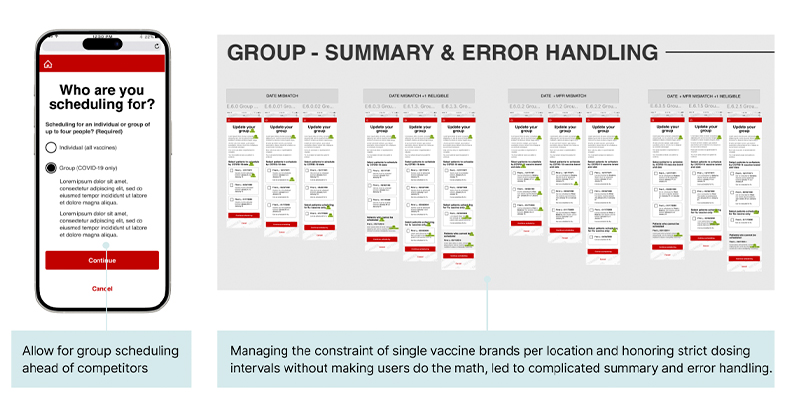
Enabling group scheduling for flu and COVID-19 vaccines, families shouldn't have to book one person at a time. Managing the constraint of single vaccine brands per location while keeping scheduling intuitive. Honoring strict dosing intervals without making users do the math.
Unifying the platform
Merging CVS and MinuteClinic scheduling into one experience. Customers saw one company, the product needed to reflect that.
CVS transitioned from Sketch and InVision to Figma, enabling the development of an enterprise-wide component library to drive consistency and enhance accessibility across the organization. With the release of the annual COVID-19 vaccine, we were able to simplify the design by eliminating complex error summaries and handling. This shift removed previous constraints related to manufacturer requirements and strict dosing timeframes.
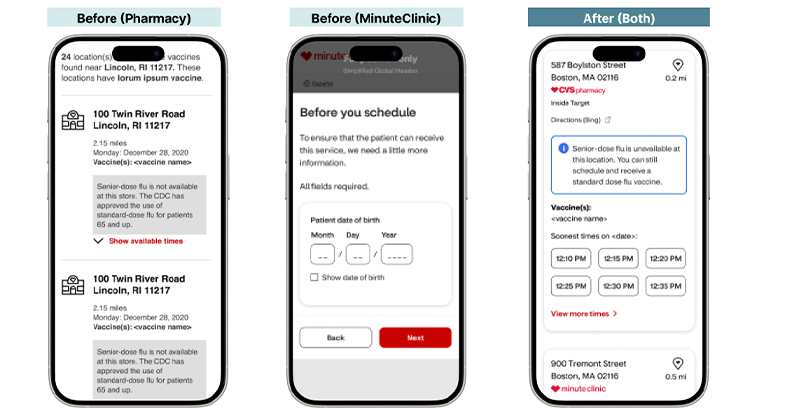
Making it personal
Remembering users and their caregiving relationships. Surfacing what they specifically need, when they need it.
We reimagined the vaccine scheduling process to deliver a patient-centric experience that reflects, "We know you." This included introducing patient lookup and authentication, streamlining the scheduling process from approximately 18 steps down to just 9. Users now have access to a comprehensive view of all their dependents on file, making scheduling easier for families. A significant brand shift from red to cobalt further aligned with the enhanced user experience.
We also introduced a map view, helping patients orient themselves to nearby locations. Additionally, we consolidated multiple lines of business into a unified interface, showcasing the full range of available services.
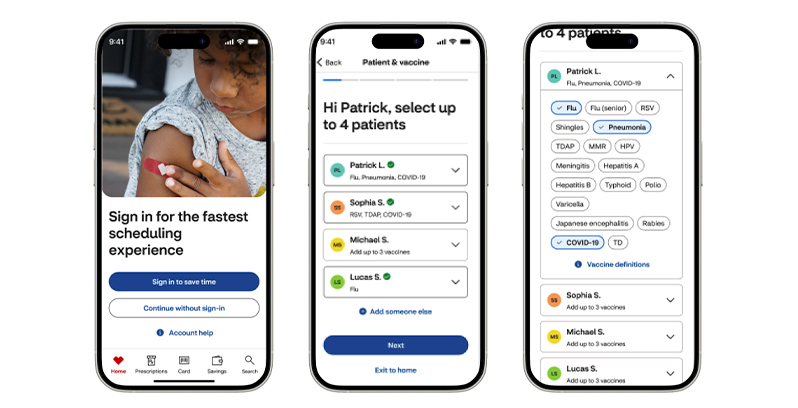
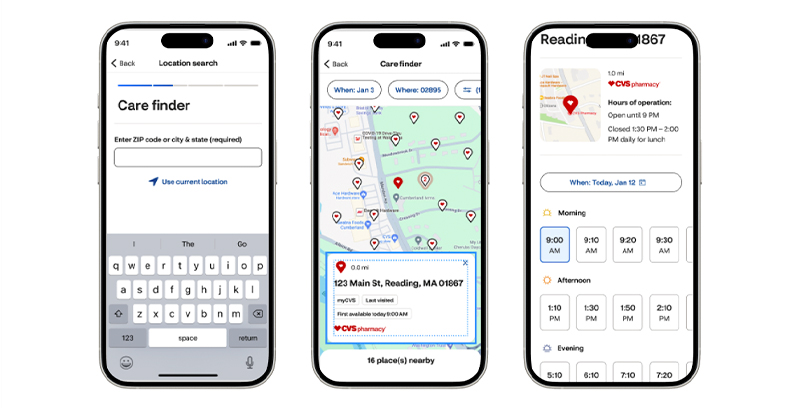
I joined the CVS scheduling team in 2021 as a UI Designer during the vaccine rollout, and over four years my role grew significantly. I co-led the launch of group scheduling ahead of competitors, transitioned into an end-to-end Experience Designer role, led the migration from Sketch/InVision to Figma, and served as the dedicated designer for DOJ/ADA accessibility remediation over a three-month sprint.
As the team expanded, I helped unify the CVS Pharmacy and MinuteClinic scheduling experiences into a single flow, implemented the CVS Design System with Auto Layout in Figma, and pushed the product toward deeper personalization, including caregiver memory, dependent management, and native app experiences across iOS, Android, and desktop. My role grew to include accessibility annotations for engineering handoff, real-time collaboration with content strategists, and regular presentations to senior stakeholders.
Designing inside a Venn diagram.
An enterprise project of this scale isn't a designer-and-PM duet. It's a constant negotiation between people whose definitions of "done" don't agree. Reading the room, and translating between rooms, was as much of the job as designing screens.
The Safety Voice
Owned dosing intervals, mixed-vaccine policy, and store-level inventory rules. Their "no" was final.
The Compliance Voice
DOJ remediation deadlines, HIPAA boundaries, consent flows, and WCAG 2.1 AA conformance.
The Outcomes Voice
Conversion, drop-off, downloads, opt-ins. Asked for personalization and consolidated services.
The Reality Voice
Component reuse, native parity, API contracts, and the fact that copy frequently arrived after build started.
The User Voice
Voice-of-customer insights, Quantum Metric session replay, A/B results, and the tone that built trust.
The Identity Voice
Owned the Cobalt brand pivot and the surface-level expression of "We know you."
My role at the seam: turning these voices into a single artifact every two weeks, annotating it for engineering, defending it in design review, and shipping the version that survived.
A continuous loop, not a linear path.
The pandemic demanded speed. Discovery, journey mapping, and persona development happened in parallel with design. This cycle ran continuously as needs shifted, new vaccine versions, eligibility updates, group scheduling requirements. Each change restarted the loop.
Measurable improvement in user efficiency and adoption.
Measured outcomes from the 2024 redesign
"This app is easier to use than it was the last time I used it in 2023. Very easy to schedule appointments, especially for more than one individual."
What I'd do differently.
This project came with inherent constraints, high public visibility, urgent timelines, and constantly shifting requirements. We often handed off to development before copy was finalized, which created downstream friction. The rollout of a company-wide design system added another layer of complexity. Developers needed time to implement new components properly while also meeting deadlines of changing needs.
Our biggest usability gains came when those constraints eased and we had room to be more deliberate. That said, the team adapted remarkably well under pressure. We iterated quickly, stayed aligned, and delivered when it mattered most. With more time and breathing room, the process could have been smoother — but I'm proud of what we shipped together.